Sunday, June 14, 2020

Review of Casio Pro Trek PRW-3500-1: The Be-All and End-All?

After the last post some three weeks back, I finally took delivery of the Pro Trek PRW-3500-1 (from hereon referred to as PRW-3500). Shipping took painfully long (almost a month to get from USA to Singapore), but it finally came and I have many things to say about it. Without further ado, let's get started with the review.

(pic of watch against yellow background)

The PRW-3500 has a spec list longer than that of a car. This was partly my motivation in acquiring this piece; I wanted to see what a high-end digital watch is capable of these days. The Pro Trek line of watches are often passed in favor of the G-Shock series, but they are actually solid contenders that often provide more digital complications for a lower price.
(picture of thick manual) caption: a 100 page thick manual covers the functions of the watch

·        Case / bezel material: Resin / Stainless steel
·        Resin Band
·        Mineral Glass
·        Bi-directional bezel
·        200-meter water resistance
·        LED backlight (Super Illuminator)
·        Full auto LED light, selectable illumination duration, afterglow
·        Solar powered
·        Low-temperature resistant (–10°C/14°F)
·        Time calibration signal reception
·        Auto receive
o   up to six* times a day (remaining auto receives canceled as soon as one is successful)
o   *5 times a day for the Chinese calibration signal
·        Manual receive
      Triple Sensor Version 3
·        Digital compass
o   Measures and displays direction as one of 16 points
o   Measuring range: 0 to 359°
o   Measuring unit: 1°
o   60 seconds continuous measurement
o   Graphic direction pointer
o   Bidirectional calibration
o   Magnetic declination correction
o   Bearing memory
·        Altimeter
o   Measuring range: –700 to 10,000 m (–2,300 to 32,800 ft.)
o   Measuring unit: 1 m (5 ft.)
o   Manual memory measurements (up to 30 records, each including altitude, date, time)
o   Auto log data (High/low altitudes, auto cumulative ascent and descent)
o   Trek log data (up to 14 records of high/low altitudes, auto cumulative ascent and descent of particular treks)
o   Others: Relative altitude readings (–3,000 to 3,000 m), Selectable measurement interval: 5 seconds or 2 minutes
o   *1 second for first 3 minutes only
o   *Changeover between meters (m) and feet (ft)
·        Barometer
o   Display range: 260 to 1,100 hPa (7.65 to 32.45 inHg)
o   Display unit: 1 hPa (0.05 inHg)
o   Atmospheric pressure tendency graph(past 42 hours of readings)
o   Atmospheric pressure differential graphic
o   Barometric pressure tendency information alarm (beep and arrow indicates significant changes in pressure)
o   *Changeover between hPa and inHg
·        Thermometer
o   Display range: –10 to 60°C (14 to 140°F)
o   Display unit: 0.1°C (0.2°F)
o   *Changeover between Celsius (°C) and Fahrenheit (°F)
·        World time
o   31 time zones (48 cities + coordinated universal time), daylight saving on/off
·        Sunrise, sunset time display
o   Sunrise time and sunset time for specific date, daylight pointers
·        1/10-second stopwatch
o   Measuring capacity: 999:59'59.9''
o   Measuring modes: Elapsed time, split time, 1st-2nd place times
·        Countdown timer
o   Measuring unit: 1 second
o   Countdown range: 24 hours
o   Countdown start time setting range: 1 minute to 24 hours (1-minute increments and 1-hour increments)
·        5 daily alarms (with 1 snooze alarm)
·        Hourly time signal
·        Battery level indicator
·        Power Saving (display goes blank to save power when the watch is left in the dark)
·        Full auto-calendar (to year 2099)
·        12/24-hour format
·        Button operation tone on/off
·        Regular timekeeping: Hour, minute, second, pm, year, month, date, day
·        Accuracy: ±15 seconds per month (with no signal calibration)
·        Approx battery operating time:
o   7 months on rechargeable battery (operation period with normal use without exposure to light after charge)
o   23 months on rechargeable battery (operation period when stored in total darkness with the power save function on after full charge)

(Picture of G-Shock Rangeman and its small display)

At 46mm in diameter (at the bezel) and 88g (on the stock strap), the PRW-3500 is a beast and has real presence. I personally find it to be aesthetically pleasing. I particularly like the three buttons on the right side, which is balanced by the v3 sensor module on the left side of the watch. At the lugs, an exposed screwbar is used to attach the straps to the watch, further contributing to its blockiness. The chunky aesthetic makes it right at home on the manliest of wrists.

The PRW-3500 features a case constructed from Casio's signature resin, which is extensively used from G-Shocks to F-91Ws. Stylistically, the Pro Treks have their own distinct DNA in the form of big displays. Initially deciding between the G-Shock Rangeman GW-9400 and the PRW-3500, the size of the display was the decisive factors in going for the Pro Trek. The positive display is highly legible and you need merely glance at it to see the time. This display is nothing short of fantastic, I think everyone will truly appreciate what a difference it makes in viewing the time when you have a display this big.

The PRW-3500 will hold its own against any G-Shock with a solid 200m of water resistance too. There are many other Pro Treks that have 100m of resistance, but the PRW-3500 seems to be one of their flagship offerings and thus, it comes with an additional 100m.

Lighting up the large display is a dual LED backlight Super Illuminator, which is activated by a large knurled button on the bottom of the watch. The backlight which is white in color is bright enough to light up the area in pitch-black conditions and makes the display highly legible in low light situations. The Super Illuminator function alone has quite a few settings that you can adjust; 1.5 or 3 seconds of activation and also automatic activation at the flick of a wrist. An interesting thing to note is that the backlight cuts out if you press a button to change modes, however if you turn off button press sounds, it will remain on when you press any buttons. A smart thing to do since you may not know what mode you are in when button press sounds are disabled, hence checking it visually is the only way to know.

Covering the display is a mineral display, but the PRW-3500 does come with a sapphire crystal in the PRW-3510 update, which will cost you a considerable markup. The scratch resistance of sapphire is nice but mineral crystals are fine for a outdoor watch for me. The next thing that catches the eye is the stainless steel bi-directional bezel marked with directional bearings that flanks the display. It isn't ratcheting, which is the kind of bezel you would find on dive watches, but remains pleasantly firm to operate and is a pretty good implementation of a bezel. The bezel is marker with north, south, east, west, and a bearing in degrees increasing in steps of 30. You can use the compass, find your target bearing, and use the bezel to store your bearing.

Flipping it over, there is impressive construction quality going on here. The caseback, which is emblazoned with a Pro Trek mountain logo, looks like the caseback from monocoque watches such as the Seiko Marine Master 300. It's a very nice caseback which wouldn't look out of place on a much more expensive piece.

On the back of the watch, we can also see the 'wrist guards' that come with the default strap. These grey pieces of plastic flare out from the lugs and function as a threshold for how much the straps can move around freely. I'm not completely sure but my guess is that Casio added these so that the straps don't flop around and maintain their angle to preserve the aesthetic when it is worn on the wrist, especially a person with small wrists.

The default straps that come with the PRW-3500 are made of the same resin as the watch case and are surprisingly nice. The upper and lower straps are printed with manly words; 'TRIPLE SENSOR' on the top and 'TOUGH SOLAR' on the bottom piece. Near the top of the wrist, there are vents that help keeps things ventilated and the back of the straps are serrated so that the keeper can lock into place firmly. There is a nice brushed buckle with a skeletonized tang to wrap it off. The strap smells faintly of vanilla too, similar to caoutchouc rubber straps. All in all, I think Casio did a great job on the strap here, I'd be most happy to keep it on the stock strap till I get bored of the aesthetic.

Now we come to the functions, which I won't go into so much detail. If I did, this article would be a lot longer than I want it to be, and also partly I'm not able to verify the accuracy of all the altitude, barometer and compass (ABC) functions given my limited knowledge in this area.

Out of the multitude of functions that this watch has, let me comment so some of the ones that I did use. I compared the accuracy of the compass against a Suunto MB-6 magnetic compass and the PRW-3500 was slightly off in its reading. I'd say it could be used as a backup navigational tool but you wouldn't want to rely on it for serious hikes where a few degrees of deviation can cause you to deviate by hundreds of meters given enough distance.

I tried out the altimeter climbing Mount Kinabalu recently and sadly, I must say that the altimeter performed appallingly. The Timpohon gate, where hikers start their ascent of Kinabalu, is 1,866m high. The PRW-3500 gave me a reading of about 1,450m. If you're doing any activity where knowing your altitude is important, you will need something else to measure your altitude. I didn't mess with zeroing the altimeter however, so you may get very different results from what I did.

I don't know much about barometers so I can't say too much about the performance of the one on the PRW-3500. There is a barometer alert function which will give a visual indication when there are sudden increases/decreases in barometric pressure. A lower barometric reading is indicative of good weather, and a high reading suggests that a storm or rainy weather might be approaching.

The sunrise/sunset feature is great, where you can key in your latitude and longitude and get local sunrise/sunset timings, or you can get timings on the fly for a given latitude/longitude. You can also get timings for a different day on the fly, scrolling through the days with the various buttons. The world time feature is also great, where you can choose a local city to stick with (most major cities included) and also check the local time for a given time zone on the fly.

Per every other Casio watch, it comes standard with the countdown, stopwatch and alarm functions. These functions are enhanced in the PRW-3500, with additions such as five alarms, and easy split lap functions due to the number of buttons available on the Pro Trek. Every function is souped up from the basic F-91W or basic G-Shocks simply because the guys at Casio could do so. I'm not entirely impressed with the volume of the alarm or the countdown timer. The best alarm would of course be a vibrate alarm, but since that is a rare feature in Casio watches, we can only rely on the sound-based alarm, which is actually quite soft. In this regard, I feel like you'd need some other tool to really wake you up at a given time and wish that the PRW-3500 had a more effective alarm in waking a person up.

No worries regarding charging as this watch features Casios's Tough Solar, which is a fancy name for solar charging. All you have to do is wear this bad boy out in the sun and it will juice itself up. The battery can last for 11 months after a full charge, and 23 months if power saving mode is turned on. Power saving mode will turn the display off when the watch has not been exposed to any light source after a certain amount of time. It's a great feature as these batteries can die if they're left on a low charge for a long amount of time, and the power saving mode can reduce the chances of that happening. You will need to make a trip down to a watchmaker if the battery inside ever dies and fails to hold a charge.

Charging the watch up to full power and having it show 'H' on the battery reserve indicator is no easy feat though. Since receiving the watch almost a month ago, I have never got it to the maximum charge and its been showing 'M' since the day I got it. You pretty much have to leave it at a window sill for a good two to three days with strong sunlight in order to get it to show 'H' at the battery reserve indicator, based on what I've read from other owners.

That said, you never have to worry about battery on the PRW-3500, it's a grab and go piece, which is exactly what I want out of a digital watch. Not having to set the time after leaving it unused for months, not having to charge it every night on a dock like a smartwatch needs to be. This is hassle-free and I've really come to appreciate it when I started work, when my mind could be thinking of trying to get to work on time, I don't want something that needs to be adjusted to the right date and time and wound up so that it can last the day.

The Pro Trek PRW-3500 is a serious contender for the best digital watch that I've come across yet. Aside from an alarm function that could've been louder, and questionable accuracy of the altimeter, it has all the functions one could possibly squeeze in a digital watch that doesn't have to be charged every week, has the water resistance of G-Shocks and looks great in my opinion. It doesn't come cheap for a digital watch at about 190 USD, which puts it on par with the Rangeman line of G-Shocks, but given a choice between the two, the Casio Pro Trek PRW-3500 is a clear winner to me.


Saturday, July 6, 2019

Stoked - A New Watch Incoming!

Well well. It's been awhile since I actually posted here, much less actually acquired a watch. But as you all know, things are never predictable around here. The Watch Post has always been a Wild West for all horological pursuits; I may claim to have attained my grail watch, and next thing you know I'm flipping it off. Therein lies the reason behind today's post.

I'm well into the working life now, and it gets real hard to update this blog as I had during my college days. Overall, I have to say that my interest in watches has also declined after the realities of life hit you once you're no longer leading a students life. Today, we're going back to school and you are all in for a treat. Yes, I made a new purchase, and it's my first watch purchase in what I believe is the first in over a year, maybe close to two.

So without further ado, let's unveil the choice of watch:

The Casio PRW-3500, in all its glory
Well, I would love to do a write-up about the features and my motivations behind getting this piece but I think I'll just do all of that when I review this piece. Until then, stay tuned!

Tuesday, May 14, 2019

Open for Business - Getat?

Someone's back in business and this business is one that I've patronized multiple times before, since way back when I was a wee university student. Without going into a long back story, let me just say that I was very surprised today when I found out Getat is still operating. A warm feeling spread across me when I saw his website up and going strong, bringing me back to an era where I was so much more carefree.

But don't take it from me, hear it from the man himself in his own words:

Hello,


Getat Watch Website already changed to

www.getatwatch.com

This is the only one website for Getat Watch


Tat do apologize any bad communication caused, late delivery for previous years.


BUT NOWADAYS, ALL CHANGED


There are 3 investers join to Getat Watch, Tat will be continuous for productions. Keep to making a cheap and good watches. Other 3 investers are in charge of Communication and Policies.


Now, we can guarantee

1) Reply email in 24 hours

2) Obey delivery policy, ship order in 5 days


You will not be ignore anymore, All emails and orders are monitored by 4 persons.


Furthermore, we have already found some new manufacturers, new products are coming.

Firstly, 44mm case will be restock, then Luminor style automatic watches, real Superluminova, new straps, 6152, 3646, new pilot watch………etc

Many many items come, if you have any ideas, tell us!!!! Maybe your idea will be our next plan.


Thanks for your time

Getat Watch

Truth is, I rarely wear mechanical watches these days. I usually grab my Casio DW5600E and rush off to work. Work has been all-consuming for me the past 3.5 years and having something that is maintenance-free is what I reach for whenever I leave the house.

However, I must say that the 45mm Radiomir offerings are really making me itch for one. It was what I wanted to buy before his website went bust. At the configuration that I would like it, it'll be a rather hefty USD 202 though, so I'm sitting on the fence about it.

This is The Watch Post though. We here seek to delight and surprise readers, so you never know when you might expect the next post to be a review of a newly acquired Getat. That's it for this short update, thanks for reading.

Saturday, November 3, 2018

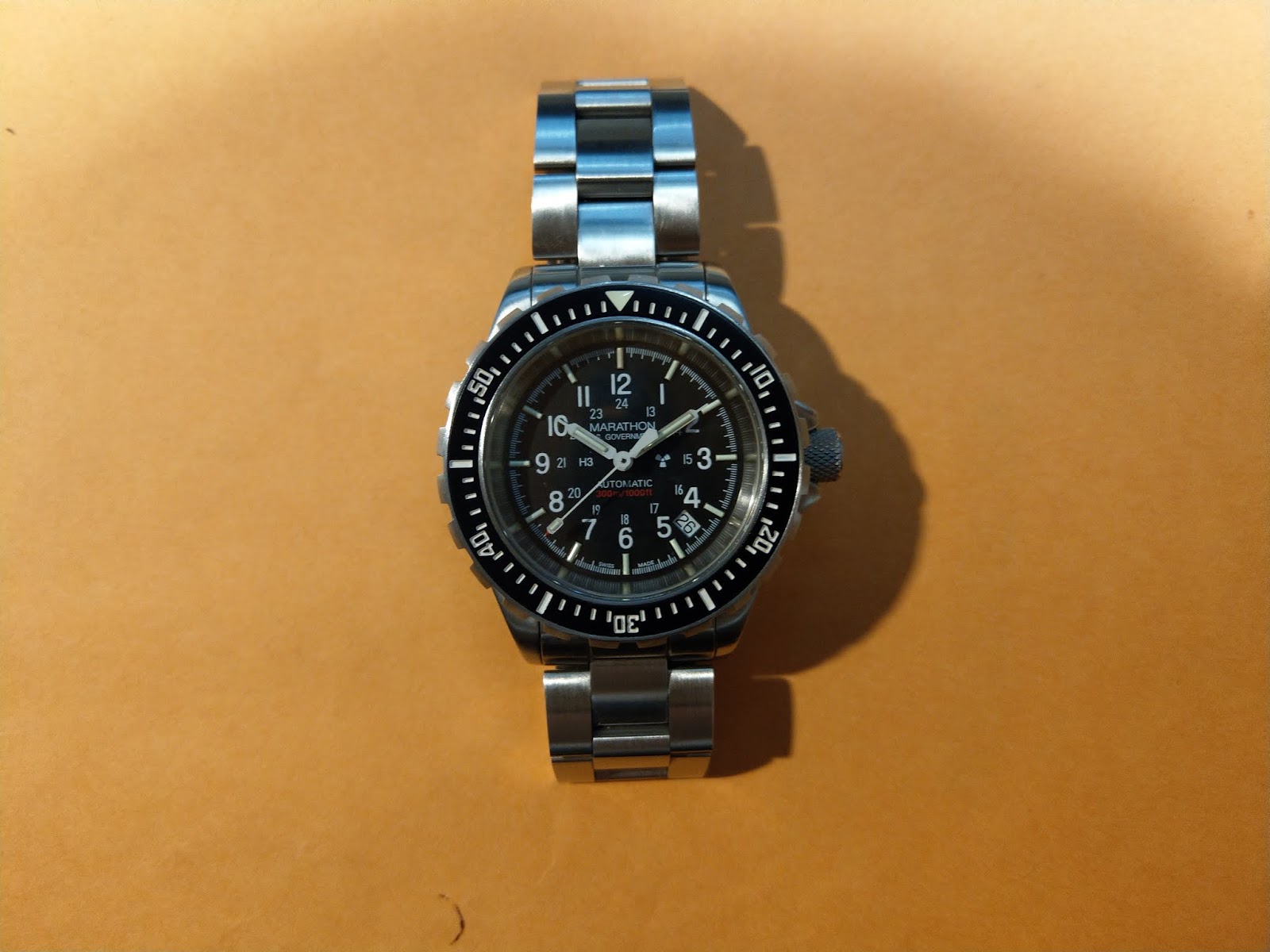
The Prodigal Son Returns - Marathon GSAR Mk II

Hi readers, its been awhile really, with my previous entry being dated some twelve months back. Since then, I've changed employment (twice actually), went on a vacation to Vietnam and just generally been trying to make progress in life. Boy, do I miss the amount of free time I had back in my college days; to be able to update this blog on a weekly basis, to think of interesting content to update this blog with. That's just life though, we're all trying to do our best in whatever stage of life we're in and sometimes that means sacrificing some things in life.

Nostalgia aside, I'm writing today to bring you a fresh update. If you've read some of my previous posts, you might remember that not too long ago, I posted a review of the Seiko SBDN025 (OK, come to think of it, it was a heck of a long time ago) where I acquired a Marathon GSAR on a whim and flipped it away just as quickly. At the time, I didn't like the amount which I had paid for it and also, the watch didn't really speak to me.

Today, I reacquainted myself with that old flame of mine, the Marathon Government Search And Rescue (GSAR). 


The GSAR holds a special place in my heart, as I wanted one since I was back in college. Of course, the thousand dollar price tag was something I couldn't afford as a college student, so I mostly looked at pictures of it, in hopes that I would someday acquire one. And I finally did, nearing the end of 2016, before promptly selling it off just as quickly as I had got it.

So, why in the world did I reacquire something that I had previously declared I had no chemistry with? For one, this GSAR was acquired at a far better price, which makes it a lot easier to stomach even if I eventually decide that this piece isn't for me. Second, and by far the more important reason; would you just look at that bracelet? The GSAR is meant to be worn on the bracelet. That's how it should come by default.

I had the GSAR on the rubber strap previously, which is a good rubber strap all things considered, but aesthetically it just wasn't doing it for me. The GSAR bracelet is where it's at; you have to pair the GSAR with the bracelet in order to appreciate the aesthetic that this watch has going for it. The industrial aesthetic that the GSAR has can only be realized when it is on the bracelet.

Now that we've covered the history of how I came to own a GSAR, let's get into some specifications:

Crystal: AR Sapphire
Case/bracelet material: Stainless steel 316L
Illumination: MaraGlo (lume pip), tritium (markers, hands)
Bezel: Unidirectional
Water resistance: 300m
Lug width: 20mm
Bezel diameter: 42mm
Case diameter: 40mm
Case height: 14mm
Lug-to-lug: 48mm
Lug width: 20mm
Weight: 116 grams for watch head


Right off that bat, the GSAR gives one the impression that it's here to get down to business. Everything about it seems like the designers were going for function over form, and there are no fanciful details such as a decorated chapter ring or a picture engraved on the caseback. Thus, there is a very industrial look to it which actually looks great.


I previously found the dial to be very busy, which I still do. Upon pairing it with the bracelet though, I sort of feel that the GSAR is able to pull it off as the rest of the watch is rather sparse, such that the details on the dial is able to disperse itself throughout the watch, if that makes sense. The highlight of the watch has got to be the tritium. Marathon does away with the usual luminous material and instead opts for tritium, making the GSAR the first tritium watch that I own (or second, technically).

Tritium tubes adorn the dial, serving as the markers for the hours and also the three hands. It's nice to have the tubes serve as the hour markers since the rest of the dial is flat anyway, and the tubes serve to give the dial some texture. However, the GSAR only features T25 worth of tritium, which makes it rather disappointing if you're a lume junkie (which I am); it's not easy to see the tritium at work unless it's pitch black, and even then you'd have to squint to see the time. The tritium will most definitely not be lighting up the dial. If you're a tritium junkie then you might want to look elsewhere, there are pieces out there which have T100 worth of tritium which should be considerably brighter, especially if they have flat tritium tubes.

Flanking the dial is the bezel, which has a very industrial look (take a shot every time you come across the word industrial in this article) to it. It features these great big notches cut into it so that you can easily get a good grip on it. I imagine this is very useful when wearing this watch underwater. The bezel action is perhaps one of the best I've ever come across; it makes a sharp, well defined click with every increment, is very precise (120 clicks) and has minimal play once it is locked into a click. Truly, the GSAR is the gold standard of bezel action as of now, perhaps till the day I get my hands on a Grand Seiko.

The crown action is along with the bezel, some of the best which I've ever come across. The knurled crown gives it a very rugged feel and threads on the crown tube are some of the most solid I've came across since the Kemmner Turtle. As always, you want to avoid the risk of cross threading no matter how chunky the threads are, so always turn the crown backwards while putting pressure on it to find the point where it engages, and you can greatly preserve the life of the crown tube like that.

Marathon has chosen to use a flat sapphire crystal with AR coating (unsure if both sides or underside only) that should serve nicely against everyday life, including accidental scrapes and bangs against a watch's archnemesis; doorways (my heart dies a little remembering how I scraped my Seiko SBDN025 against a metal doorway, the mineral crystal stood no chance against the metal and I was left with a nice memento). Legibility is very good, since the AR seems to be doing its job really well. Sometimes it seems that the crystal just isn't there at all.

The watch head itself already weighs in at 116g, making the GSAR a hefty piece. With the steel bracelet, it approaches 200g (depending on how you sized it) which is pretty substantial. Put it on the wrist though, and the weight of the watch head and the bracelet cancel each other out, resulting in a very even distribution of weight along your wrist. As a result, the GSAR on the bracelet is one of the most comfortable watches I've even worn.

There are lug holes on the watch head which makes it easier for you to remove the bracelet, if you so wish. While some feel that lug holes detract from the aesthetics of the watch, it personally doesn't bother me as they're really small anyway, and they can be really useful if you don't want to scratch your lugs to oblivion when removing the bracelet.


Now, the bracelet is just a work of art. It is very nicely machined, and the links are seriously chunky. This is the best bracelet I've ever come across since getting into watches. If you happen to come across a GSAR, you'll understand when you put it on for the first time. The links and end links are all completely solid (as opposed to hollow links commonly found on cheaper watches), with a double screw system used to secure the links to each other; very different from the link system I've came across on Chinese manufacturers (Longio, Fullswing Industrial).

Basically, with the single screw system that I've seen on Fullswing Industrial bracelets, there is a possibility that the screw may come lose from everyday use, since the links of the bracelet are moving around as you have the watch on and go about your daily business. They may slowly be loosening themselves. With the double screw system, this possibility is negated as the tightness of the screws are independent from the movement of the links. The result is that the links of the bracelet are very relaxed (i.e. the tension from tightening the screws does not affect the movement of the links, as they sometimes can in a single screw system), and will fit on your wrist comfortably without any awkward tension between the links.


The bracelet is topped off with a double clasp bracelet, which unfortunately doesn't match the quality of the rest of the bracelet as it is stamped instead of milled. In this regard, it is sort of disappointing since the clasp seems tinny compared to the rest of the watch. The clasp does features a simple divers extension (which is a long ways away from Tudor or Seiko diver extensions which are leagues above), and my particular clasp was adorned with a US Great Seal which just makes the watch that much more interesting.

Timekeeping is made possible with the venerable workhorse movement, the ETA 2824-2. Not much to be said here, since I don't think that Marathon did any modifications to the movement, therefore you can expect a similar performance as you do with any other watch that runs a 2824-2. As always, I really like the instant date change on the 2824-2 movement, and my GSAR snaps to the next day at 12 sharp so I've got that going for me. Timekeeping has been very good on my piece; I'm gaining just five seconds a day, which I am very pleased with. As usual, it's a luck of the draw but fret not, movements can be regulated to run faster or slower. The more important thing to me is the precision as opposed to the accuracy.

The GSAR, upon revisiting it, turns out to be an awesome watch with one or two drawbacks.
Something that didn't live up to expectations was the illumination, which certainly does not do tritium justice. Beyond that, it would be nice if the GSAR was cheaper, but I certainly like the quality that I got with the GSAR, which is a definite step up from Chinese manufacturers such as Fullswing, so that should be taken into account of the price. It clearly places a focus on function, which results in a very industrial look that ends up being aesthetically pleasing as well.

In closing, one really get this sense of being a government agent when wearing this watch, which is really awesome since these watches are actually standard issue at several US government agencies. While it is far from what I consider to be a luxury watch, I find that this watch is potentially far more interesting, conversationally or otherwise. It is rarely seen in the wild (Rolexes and Omegas are everywhere, though it's supposed to be part of an exclusive club) and the interesting heritage behind it just makes for such a fascinating conversational topic. Whether you're protecting the President of the USA or just a watch enthusiast, rest assured that the GSAR has you covered.

PS In other matters, its been so long since I last made a post and I thought I might give you guys a short update, so you know that I'm still alive and what to expect from the future of The Watch Post. I started this blog in my early twenties and unbelievably, I'm already in my late twenties now, with the thirties not too far away.

My interests have shifted considerably, be they in watch preferences or making content updates. For one, my sartorial choices are now mostly relating to things which I may bring to an office (i.e. my bag, watch and shoe choices are now made in terms of whether they're OK to use in an corporate environment). My latest fixation; duffel bags, and I do actually have one in the mail right now (hint: it's the Thule Subterra Duffel) which I intend to review when it arrives. Second, my hours spent at work means I have much less leisure time, which used to be in abundance while I was in college. Naturally, the frequency of updates has plummeted.

I just want all readers (which I am thankful for) to know that there will definitely be updates to The Watch Post, I aim to get a post out every few months reviewing a new piece of gear or share with you some of my thoughts and observations of the world. Until then, thanks for reading.

Monday, October 23, 2017

Review of Mystery Ranch Urban Assault Backpack

It has been a heck of a long time, readers. So much has happened in-between this post and the last. I underwent another ICT, I've been working my ass off (as usual) and best of all I went to Japan for one hell of a vacation. Indeed, much has happened since I last posted, its been five months after all. Not much has happened in the way of watches unfortunately, I'm still with my collection of three at the moment (G-Shock, Seiko SBDN025 and Mini Fiddy homage) but headway was instead made in another area, namely, backpacks.

It was in Japan where I got frustrated with my current backpack (Direct Action Dust) as it did not allow for easy access to the main compartment. After having experienced the clamshell design on the 5.11 Rush 12, there was no going back to a traditionally designed backpack for me. A clamshell makes your life infinitely easier. It was a pain in the ass having to load items from the top into the Direct Action, especially bulky items where you had to fight with the size of the opening. It was then I knew that the Direct Action Dust's days were numbered; I had to find a replacement that allowed for easy access to the main compartment like the 5.11 did.

Enter the Mystery Ranch Urban Assault.
The Urban Assault, customised with paracord running through the bottom pull tab
  •     500D CORDURA fabric and YKK zippers
  •     3-ZIP design for quick access
  •     Two internal zippered accessory pockets
  •     Fixed harnessing
  •     Volume: 1282 cu-in (21 L)
  •     Weight: 0.9 kg
  •     Dimensions: 58 x 34 x 25cm

While I've only reviewed two other backpacks on this blog, having a good backpack has been increasingly important to me over the past year and a half. I like to think that this is due in part due to my increasing wanderlust, but it's probably mostly because I'm a gear junkie. The 5.11 Rush 12 was a great backpack, but the thing that really got to me was the lack of ventilation on it. I perspired like a pig carrying that thing due to the lack of mesh backing, so it was away with the 5.11 Rush 12. In came the Helikon-Tex Raccoon, which was a decent backpack especially for the price, but that got stolen while I was vacationing in Italy.

Without much thought, I chose the Direct Action Dust as a successor to the Raccoon, thinking that I could get used to traditional opening backpacks again. As mentioned above, this was not to be so; the opening on the Dust made life pretty difficult for me while in Japan, which is sad because it is an otherwise excellent backpack.

So, I've learned my lesson. As much as possible, I require all my future bags to have some form of easy access to the main compartment. It just so happens that Mystery Ranch has a very novel approach to this problem; their signature 3-ZIP design, aka Tri-Zip or Y-Zip, so named because of the shape the zippers form. With the Y-Zip design, I pretty much have access to the entire storage compartment, though not as easily as compared to a clamshell backpack. This is good enough for me though.

The Y-Zip does provides some benefits over a clamshell, however. You can simply unzip just the top two zippers and the bag now behaves like a top loading backpack. Sometimes, you may only need to access the top of the backpack, perhaps to throw something in or take out something that is sitting on top. You can also unzip the vertical zip that runs along the length of the backpack without undoing the other two, and this zipper alone allows you access to something like 60% of the backpack. These are things which aren't possible with a clamshell; there is only one way to open it and sometimes you risk spilling out the contents if hastily done. All in all, the Y-Zip is a unique approach in allowing easy access to the main compartment and most importantly, it is an effective one.

These are all things that come at a price of course. Mystery Ranch packs do not come cheap at all. Where I'm from, the Urban Assault will set you back some SGD 280 (USD 206 at time of writing). Thankfully, I got mine for considerably less as I got it used. Even still, this is merely an introductory price when compared to the rest of their catalogue. Of course, it wouldn't be fair to pass judgement solely by virtue of their pricing strategy which is why we'll conduct an in depth analysis on what really counts; the product.

The Urban Assault is a long and thin pack that can easily pass off as a streetwear brand such as Supreme or Gregory. The Y-Zip design gives the pack a distinctive look, and if you get the pack in the Multicam colorway, you'd fit right in with the hypebeast crowd. I think it's a stylish pack overall and you wouldn't be out of place carrying this to school or work, nor would it look flimsy if you took it out to the woods for a weekend.

The pack is constructed from 500D Cordura, which is plenty strong, though some purists may prefer 1000D Cordura. Do note however that the pack already weighs over 1.2kg as it is, so I'm glad they kept it to 500D. The zippers are all YKK with giant zipper pulls and a length of paracord woven with it, making everything very easy to pull, though the zippers do make quite some noise as they tend to clang together while you're walking. The length of the zippers are rubberised which makes it harder for water ingress to happen, though I really wouldn't count on the contents staying perfectly dry if you were walking through a storm.

The capacity as stated on the manufacturer's website is stated as 21 L, though some retailers list it as 24 L. In either case, I have been able to store far more in the Urban Assault than I have the Direct Action Dust (rated 20 L capacity). I struggled to get an A5 sized book, a denim jacket, a hard carry case for my GoPro (about A5 size as well) into the Direct Action Dust's main compartment. The Urban Assault can take all those and there's still about 50% of space left. The 20L of space on the Dust was of course, representative of the space in the admin pouch and other compartments as well, meaning the main compartment was perhaps 17 L or less (numbers by gut feel, no measurements done). On the other hand, the bulk of the capacity in the Urban Assault lies within the main compartment. Aided by the Y-Zip design, I've just been able to store so much more in the Urban Assault as compared to traditional open packs of around the same capacity.

If you're big into hydration bladders, I hate to break it to you but the Urban Assault is not bladder friendly. There's no opening for your pipe to pass through, unless you're willing to mutilate the pack yourself. While I don't frequently use a hydration bladder, it would be nice to have support for one as this pack has absolutely no provisions in terms of hydration (i.e. there are no external pouches that allows for quick access to water bottles, besides keeping it in the main compartment).

Glorious, glorious mesh
The flimsy pull handle covered in paracord, much better
Turning the pack around, we can see that the entire back is covered in mesh, allowing for some ventilation at least. I definitely found myself sweating carrying this, but then again where I live, I haven't found a pack which I didn't sweat while carrying. The underside of the straps are generously padded with said mesh too. These straps are beefy as hell, they are perhaps a half inch thick and they're comfortable as hell too.

Which brings us to the carrying experience that is the Urban Assault. I was pleasantly impressed at how comfortable it was while on my back. It followed the contours of my body very closely, making for a very good fit. Mystery Ranch, who has been crafting backpacks for mountaineers and military personnel, are especially known for their elaborate suspension setups, although you won't find any of it on the Urban Assault. Instead, the Urban Assault has a fixed harness system which is essentially a fancy name for what you will find on any normal backpack.

Frankly though, the straps on the Urban Assault will more than serve their purpose and I didn't find myself wishing that it came with a more elaborate setup. A suspension system would likely be overkill on a pack like this, not to mention the price increase that would come with it. Overall, the comfort of this pack is a considerable step up from any previous packs I've owned.

There was something that didn't quite match up with the rest of the pack though. Namely, the carry handle. Being rather long, but yet constructed out of a single piece of 500D Cordura, this thing is soft and floppy as hell. It is unable to hold any shape on its own and seemed as if it was added onto the pack like an afterthought. I pretty much took an instant dislike to it after first handling it and proceeded to wrap the hell out of it in paracord. Now, there is finally some rigidity to the carry handle and I can grab it much more easily in most situations. Thankfully, this is a flaw with the pack that can be rather easily fixed with some paracord, a lighter, and some free time.

The next issue isn't nearly as easy to fix, if it is even possible. It's that the Urban Assault lacks any sort of compression straps, at all. Not even the kinds such as those on the 5.11 Rush 12, which themselves can hardly be considered compression straps. This of course, presents a problem, especially when you've got many big, bulky items or soft ''airy'' items in your pack.

Now, while it may be possible to customise some form of compression straps, I don't see any graceful solution whereby you can maintain easy access while compressing it effectively. You could possibly use luggage straps but there would be a big hit to ease of access. For some people, the lack of compression straps may be a big turn off while for others, such as myself, I've been able to live with having no compression straps. In short, caveat emptor; depending on what you intend to carry and if compression straps rank high in importance to you, the Urban Assault is not your pack.

Another point with the Urban Assault is that it is pretty spartan in terms of organization. You will not find anything akin to the admin pouch that most tactical packs have. The storage compartments do not have slots for pencils, pens and neither will you find velcro pockets for putting gear such as a radio. Again, if you have a requirement that all your gear must have assigned locations within your pack, the Urban Assault will not be suitable for you.

There is an easy access pouch on the lid which when opened, will reveal a dangling hook that allows you to hang items for easy access (I have a lighter attached). That is about as much organization as you will get on the Urban Assault. Most everywhere else in the Urban Assault (save for two pouches on the sides and two laptop sleeves), the storage is just one big compartment where your gear will mix together in a free-for-all.

In closing, the Urban Assault can potentially be a great pack. It looks good, wears great and is just so convenient to access. Whether you'll love this pack hinges on a couple of things; do you absolutely require a pack which allows for specific organization? Will the lack of compression straps and easy access to hydration be a deal-breaker for you? Perhaps most importantly, are you willing to accept these shortcomings while paying a considerable sum of money for it? If you've gone through these considerations and are willing to accept the flaws, I think you will find that the Urban Assault to be one sweet pack.

Sunday, May 21, 2017

A Visit to Sungei Road Thieves' Market - My Thoughts and Rants

Welcome to The Watch Post, readers, and today we'll be taking a little detour from our usual review.

Firstly, if you don't already know, I am based in Singapore. At just over 700 square kilometers, Singapore is a tiny place, and is in fact one of the smallest countries in the world. The government enforces the rule of law with an iron hand in this country, not just in jurisdictions such as criminal offences but to areas such as recreation and leisure as well.

Case in point, shisha (or hookah), one of the main draws for visiting Arab street (our hipster area) was banned in July last year. In the name of fairness, I should disclose that the government gave one and a half years notice in before the ban was actually enacted. Then, there was also the restriction of alcohol consumption in April 2015. While it is true that these bans were to address legitimate concerns (tobacco being bad for health in general and the alcohol ban due to the 2013 Little Indian riots), I feel that the way these laws have been passed are a very high-handed way to handle things.

I fondly remember the days what clubbing was like before the alcohol ban kicked in; it was a rite of passage for young Singaporeans to sit along quiet roads for pre-drinks, getting wasted on alcohol that had been obtained from outside the club (much cheaper). The trash talking that ensued when everyone was starting to get tipsy was where things got really fun. This is rarely an option these days, as public consumption of alcohol after 10.30PM is against the law. Way to go, nightlife in Singapore.

Sadly, I must say that the trend of high-handedness continues. Come 10th July this year, Singapore's only perpetual flea market that has been operating for over eight decades will be forced to cease operations. Also known as the Sungei Road Thieves' Market (so called because thieves would allegedly sell their stolen/illegal goods here in the 1930's), the loss of a flea market is significant because this is the only such flea market in Singapore. Anyone can setup shop here and peddle their goods (as long as it is not new, part of rules to sell here), without paying rent whatsoever. This is the entire premise of the flea market.


Strangely, I have never been to the Thieves' Market all my life. So, knowing that its days are numbered, I paid a visit to Sungei Road today. Unfortunately, and I apologize in advance, I didn't take any pictures of the goods being peddled. Know this though, if this is being posted on The Watch Post, that's because it involves watches.

You can just about find anything here, though I would seriously doubt the functionality of the electronics sold here. There was clothing which looked very well-used, old pottery and stamp collections, vinyl records and pirated DVD collections, heaps of electronics (old Nokia phones, Sony Ericsson Walkman phones which reminded me of my secondary school days), and lots of watches as well. Some of the items here are so well-used that well, to be honest, I'd call them junk. As in they were literally what you'd throw into the trash, but are instead being peddled here. And I loved it everything about it; the kind of goods being sold, the makeshift shelters and sales stands, shady sales practices were all part of the experience that brings one back to a different time. I imagine before Singapore became so built-up and before everything became so regulated that many more marketplaces were actually like that.

Why is it going away? Two words; residential development. The cynical side of me is thinking 'Why the hell do we need another residential development?' Granted, the flea market is right smack in the middle of some very prime land. Do we really need another residential development to be exactly here though? Especially when the cost of developing this residence means that we have to give up on something so culturally significant.

The flea market is at the heart of Singaporean culture; it cannot get any more Singaporean than this. During my visit today, I saw uncles engaging in the fine art of salesmanship, Singapore-style. That means with lots of Hokkien expletives thrown into the mix, and half-naked uncles in their 60's and 70's puffing on cigarettes as they persuaded you to buy their wares. Certain hawkers were blasting the radio through loudspeakers and providing a service to their neighbours (or disservice?). Haggling was happening to my left and right. Where do you get to see all that in a modern shopping mall?

Of course, I realize that I enjoyed this experience only because it is novel. I'd rather quickly get irritated by the lack of regulation if I had to go about my daily chores at such a marketplace. But that's exactly my point; this is the only place left in Singapore where one can get such an experience. With that, I think the closure of Sungei road flea market will be something that just makes Singapore that little bit duller, something which the government has been getting very adept at over the past few decades.


My experience at Sungei road was absolutely delightful and I highly recommend anyone who can to pay a visit to Sungei Road Thieves' Market before it is all over. I think you will find that the Thieves' Market will give you an experience that can hardly be replicated in your generic Orchard road shopping mall. It's dirty, it's hot, it's full of goods without pretty presentations and most of all, it is a novel, refreshing experience. This country continues to surprise me with its quirks and oddities, even as I think I'm about as true-blue as a Singaporean can get. I just pray that the Singapore government will stop destroying our own culture as they go about preaching on the importance of the Singaporean identity.

Wednesday, May 10, 2017

Review of Panerai "Mini Fiddy" Homage - Return of the Getat?

So, it has been almost three years since my attempt to order a Getat Mini Fiddy, after I was impressed by the quality of his Luminor homages. The review of that piece never materialized as the watch was not functional when I took receipt of it. The events that unfolded after left me wanting to put the entire experience behind me and never think of dealing with Getat again. Today's post hasn't bucked that trend; I haven't had any dealings with Getat since then.

Not like it matters much honestly, from what I can see, Getat is either in the process of exiting the watchmaking business or he already has. His website hasn't been updated since he introduced his new 1:1 cases for the Luminor, Fiddy and Radiomir lines which was years ago. He has only had one case option (PVD black) for the Fiddy range of watches for years now and hasn't restocked since. The last email which I sent to him in November last year bounced back. Perhaps Getat has finally decided to throw in the towel after years of receiving PayPal disputes, or has just grown tired of watchmaking in general. For better or worse, I think it's just sad that the consumer has one less choice in the market.

Regardless, I managed to come across a Mini Fiddy homage recently on the used market, which the seller informed me was in fact a Getat. This was of course, perfect for me. In spite of the bad experience with Getat three years ago, I actually continued wanting a Mini Fiddy homage made by him. To me, the level of customization plus the price for which he offers them made his homages more desirable than the ones from other sellers such as Jackson Tse or Davidsen. Knowing that I had to fill the void in my heart, I met up with the seller and we transacted. And there it was, a Mini Fiddy was mine. Without further ado, I present to you: Getat's Panerai Mini Fiddy homage.


And the specifications of this build are as follows:

- Case style: 44mm "Mini Fiddy"
- Dial: Matte black dial with Marina Militare wording
- Buckle style: Pre-V
- Case option: Brushed steel with polished bezel, see-through caseback
- Dial lume: Super-LumiNova C3
- Hands lume: Super-LumiNova C3
- Crystal: Sapphire with AR coating, mineral crystal for caseback
- Hands color: Gold
- Movement: Normal stainless steel
- Stitch color: Black
- Strap option: Vintage wooden brown

A quick note before we commence with the review, I cannot guarantee with complete confidence that this is a Getat. Parnis and Marina Militare homages sellers are a dime a dozen these days, and I've seen some from Parnis which look exactly like my piece. The only telltale sign I have that gives me some confidence is the strap. My previous Getat has a strap with the exact same style of stitching as the one here. This is the only form of confirmation I can provide unfortunately. For the purposes of this review, I will be assuming that this is from Getat so please be aware that this may just have been a Parnis/some random PAM homage in actual fact, and that your expectations may be skewed if you are intending to buy a Getat based on this review.

To start off, let us appreciate some of the rich history behind the Fiddy, otherwise known as the 6152-1. Initially created as the answer to the Italian Royal Navy's calling who commissioned Panerai to produce a dive watch for them back in the 1950's, the Fiddy has come a long way since then. Coming in at 47mm, the Fiddy is a large watch even by today's standards, and must have been an absolute beast back in the day. Today, owning an original Fiddy from the 50's is an affair that will set you back hundreds of thousands. Panerai, in acknowledging the popularity of the Fiddy design, have themselves released many homages of the original Fiddy. The first homage of the Fiddy was the PAM127, released in 2002. Since then, there has been the 212, 213, 210, 233, 270, 311, 317, 275 as well.


But wait, didn't the title mention "Mini"? Indeed, the Mini Fiddy comes in at a "measly" 44mm in diameter, a size which Panerai has never officially produced. The 44mm was probably the brainchild of some Chinese rep maker who, somewhere along the line, felt that there was a sizable market for Fiddy lovers who wanted it to be smaller. Thus, the 44mm "Mini Fiddy" was born. The Mini Fiddy is the modern-day Fiddy equivalent of a Luminor. Make no mistake though, the Mini Fiddy is hefty. It has a real presence and weight to it, and one can definitely feel it on the wrist.


 Two things set the Fiddy design apart from the Luminor which we've all come to know and love. The first of which is the design of the case itself. As you can see from the above comparison, the Fiddy case features lots of curvature which stylistically is a very big departure from the Luminor, which is generally a watch that features much straighter design throughout. The curves on the Fiddy are quite enchanting to say the least, I usually spend a good minute or two appreciating the shape unconsciously whenever I am handling the Mini Fiddy. The case itself is made to a quality that I am very satisfied with. There are no machining marks obvious enough to notice and the finishing is most satisfactory. The case comes in a fine brushed finishing that has been very well done while the bezel is polished. Top marks for the quality of the case.

PAM127 on the right, notice the extremely pronounced bubble crystal
The other distinctive feature of the Fiddy was the extremely pronounced bubble-like crystal. Supposedly, this made reading the watch easier when one was underwater. Not so much on Getat's Mini Fiddy though, as it only features a domed sapphire crystal which is a far cry from the original. Sapphire, as we know, is not the easiest material to work with. To put a bubble sapphire on the Getat probably meant that prices would be jacked up considerably or either that Chinese rep makers just had a hard time replicating the shape of the original. While it's unfortunate that a core aspect of the Fiddy DNA is not replicated here, a domed sapphire with AR coating is still very nice on its own.

Not so much on the Mini Fiddy homage
 The dial on this piece has seen upgrades since my last Getat. You can clearly see that the words Marina Militare punched into the dial, as the indentations are highly visible. I believe this is how authentic PAM dials are like too, so apparently these Chinese rep makers have been stepping their game up. As with the Luminor homage, this piece features the famous sandwich dial as well. The sandwich dials is a nice variation from the usual run-of-the-mill printed dials. To further accentuate the aesthetics of the watch face, we throw a set of gold-colored hands into the fray. As you may have guessed, these hands are reflective as hell and they have a way of dancing with the light that hits them. There appears to be some dirt or fingerprints of sorts on the tips of the minute hands, though I have to say I'm not OCD about these kinds of things and it hasn't subtracted from my enjoyment of this watch.


Next, we'll go over a favourite topic of mine in analog watches; lume. We'll be going over two aspects regarding this; performance and application. To kick things off, let's just say that the lume on this piece is phenomenal. I'm talking about performance that is nearly on par with Seiko, which is absolutely astounding for a rep. Seiko, as we all know, are kings in the game of lume performance and their lume is about as good as you can get with luminous paints. Chinese rep makers don't have the facilities that are availed to Seiko, and how the rep makers are able to put out this level of lume performance really surprises me. 

Compared with my Seiko SBDN025, these two are really neck and neck. The Mini Fiddy is capable of the "daytime bloom" effect, which is the event that happens when you walk from a sunny outdoor area into a well-lit indoor area but the lume on the watch is still screaming with brightness. Still, I'd give the Seiko as having a most discerning edge over the Mini Fiddy. Application is nice, clean and even, with no visible specks and blemishes as was the case with my previous Getat. This level of consistency almost makes me think that the lume was machine applied (or perhaps it really was?). Regardless, I was absolutely blown away by the lume on this Mini Fiddy and it has far exceeded my wildest expectations. This is not just C3 lume in name, but also in performance.


The front of the Mini Fiddy is a marvel to behold. Everything about it hits the right spots. A nicely domed AR coated sapphire, a dial that is several steps up from my previous Getat, gold hands that dance with the lights and spectacular lume performance. I have a feeling that if you're able to get hold of a Getat which has been well-made, you'll be marveled at the quality as well.


Flipping it over to the back, we once again see the same movement that was in my previous Getat, a Chinese-made 6497 which I believe is running at 2.5Hz (18,000bph). Again, you can see the Panerai-esque bridges, which the makers have done a commendable job on. In terms of timekeeping, I shall update when I get the chance to measure it over a period of time (it's not the easiest to test when PAMs have markers in 5 minutes divisions). The thing about Chinese-made clones of ETA movements is not that they are poor performers or are mechanically inferior, but rather due to their suspect QC and assembly conditions. They are often poorly lubricated out of the factory and have random particles trapped in them (think human hair, skin) due to the less strict controls while assembling. Overall, while I'd say that these Chinese-made 6497 clones are good enough for what they do, I'd much rather have a plain-looking authentic ETA 6497 beating away inside, knowing it has gone through ETA QC.


Looking at the crown guard, I have good things to say here as well. Steps have definitely been taken to improve the quality in this aspect. When flipped out, the lever no longer flops around like my previous Getat did. The lever now features a roller at the part which comes into contact with the crown, meaning it no longer scrapes the crown as you push it back into the lock position. The tension to open/close the lever has also been much improved; it needs more force to be opened/closed now and really seems to be pushing the crown into the case which is an important aspect of water resistance. With that said, I still don't ever recommend submerging any sort of PAM homage into any form of liquid, regardless of the water resistance claims made by the seller. Perhaps the cases were really manufactured with water resistance in mind, but it is the assembly that I wouldn't place my trust in. Water resistant assembly techniques (lubricating O-rings etc.) is as important towards achieving true water resistance as is the design of the case.


By now, I apologize for having drawn so many comparisons with my previous Getat, but I have to do another with regards to the strap. I believe this is the Hazel Grey strap with the Pre-V buckle. Qualitywise, this is the same as the one as my previous Getat, which is to say it's decent for the price you're paying. It's no Ted Su or Jules Verne for sure, but it is good enough for you to wear while you hunt for a better strap. PAMs are so versatile when it comes to straps and the ease of changing straps with those screw bars makes it such that even if this strap was terrible, it wouldn't be much of an issue. For what it's worth, the strap here won't amaze you, but it is a decent enough strap.

This has been one of my longest reviews and I've covered the areas which I thought were more interesting. I'd like to wrap up this review with my conclusions on the venerable Mini Fiddy. The build quality of the watch head itself has improved considerably over my last Getat, which in itself was already quite good. There have been significant improvements made to the case build quality (especially the crown guard), the dial, and the lume. The movement itself remains the same, which is a solid workhorse though QC remains a problem with these Chinese-made movements. The strap is also decent enough, and is a part of the watch that can easily be replaced if you're unsatisfied with it. Overall, I am very happy with this acquisition. When you look at it as a whole, it really surprises you what you can get for SGD 250 on the rep market these days. Justifying a luxury watch is a hard thing for me to do, which is why I'm so glad that these Chinese makers exist and it is for the same reason I'm sad that Getat seems to no longer be actively in the scene.


I'd just like to end off this post with a reflection on the state of the collection. I have three pieces now (Seiko SBDN025, Mini Fiddy homage and the Casio G-Shock DW5600E-1V) which I feel puts me in a very good position right now, horologically speaking (if there is even such a word). The Mini Fiddy serves as the watch I wear for work as well as for formal events. The G-Shock serves as the watch I wear when going to the gym, a run or going to reserve army call-ups. The SBDN025 fills the gap in-between; it feels just at home in a formal environment as it does at the gym.

On a side note, I'm happy that I didn't give up on my interest in watches totally, which I almost did during the later parts of my university days. I'm also glad that I maintained the blog (even though reviews have been getting fewer and further) but the fact is that I just do not acquire watches at the rate I used to when I was a student. Incredible as it may sound, reading my old posts not only allows me to review my writing skills back then but also allows me to review my growth as a person. I am able to look back at the me who was writing the post at that point of time and see what has changed in me since then. I'd like to take this time to thank any readers who has faithfully come back to read The Watch Post time and again, it has been a real pleasant journey with you all.